Showing posts with label classroom management. Show all posts

Monday, 1 June 2009

7 Tips for Hot Weather

It's going to be 26 degrees in London today. I teach on a 5th floor classroom with south-facing windows, and no air conditioning. Even worse, we've had catches installed on the windows so they only open 4cm. Joy.
So, here are my tips for dealing with the heat.

1. Get tissues. I dedicated an entire post to this matter here but seriously, kids get sweaty faces and they need to rub down as they come into the room.

2. Open windows early in the day. As soon as you get in, open windows and prop the door to ensure flow of air. Even if outside traffic noise is unbearabe you will have to be louder. I explain to students that today we deal with the noise in order to stay alive.

3. Water Bottles - Encourage students to bring water bottles to school and ask them to put them on their desk. My rule is that fluid must be see-through and not fizzy. If students get head-aches or hot, encourage them to keep drinking.

4. Use Settled Starters - During hot weather I have a starter sheet on the desk for each pupil at the beginning of every lesson. It should be something really simple, i.e. a wordsearch or cryptogram. Doing this will encourage them to sit down and concentrate - giving them time to cool down.

5. Turn computers off - If you have computers in your room, switch them off completely. They will be generating a surprising amount of heat that you can do without.

6. If you bend rules, be consistent and explanatory - At the beginning of the lesson state what the new rule is, why it is has changed and how long it will last. For example: "The rule is that you must wear your blazer in class. Today it is very hot so I will change this rule today only. You may take your blazer off and put it on the back of your chair. (wait for movement). Tomorrow I expect you to have blazers back on, unless I say otherwise."

This works because students appreciate you thinking about their comfort but they realise that hot weather does not mean classroom procedures suddenly go out the window.

7. Get outside in your breaks! Enjoy the weather while we have it.

Friday, 29 May 2009

Homework Excuse Notes - Downloadable Template!

Collecting in homework is a chore for many reasons but one of the most difficult is managing student excuses. While I'm fairly hard-line with students I feel like a 'no excuses' policy on missing homework is unfair. In the past students have been required to flee their homes in the middle of the night to avoid abusive parents, or were locked out all night by neglectful ones. Heck, I even remember one 14-year old girl who spent the night in a cell as her mother falsely accused her of assault so that she could spend the night partying. Sure, homework is important, but giving a student a punishment without listening to these circumstances is only going to make their situation worse.

That said, when I'm dealing with the collection of 30 papers, listening to excuses is tiring. Particularly if they are of the "I lost my memory stick" variety. I therefore insist that every student hands in a piece of paper -- if they don't have homework, they turn in a Homework Excuse Note. The format of this note was stolen from somewhere many years ago and adapted to my classroom needs (I can't remember where so if anyone recognises please let me know!).

The note works for 2 reasons. One, it is discrete, meaning that students with real problems write without having others over-hear and it doesn't make for a din in the class when 10 students try to explain why their work is missing. Secondly, it is on paper as physical evidence of the excuse. Students are reluctant to commit lies to paper, particularly as they know I check stories (wherever possible) during my homework-marking sessions. If they lie, I have proof. I also keep all the notes in my class records so I can discuss them with parents if required. The dread of this means that almost all students get their homework in on time - mission accomplished!

Update - I found the website I stole this from, it's http://www.teachertools.org/forms_dynam.asp. A brilliant site with hundreds of free templates of forms that teachers might use - e.g. hall passes, homework passes, etc.

Tuesday, 19 May 2009

5 Key Items Every Classroom Needs #2: A Koosh Ball, Teddy Bear or Skull

In 3 Tips for Whole Class Discussion I mentioned the use of a conch - i.e. something students must hold in order to speak. Whoever has the conch has the right to be listened to by everyone else in the room (including teachers and TAs).

Interesting items that can be safely thrown around are vital to behaviour management. Conches are uesful for quick Q&As, picking volunteers or managing confused discussions about homework expectations. Whenever talking gets out of hand, I go back to the conch. It takes practice and clear judgement at the beginning of the year to drill its use. With younger groups we spend time practicing 'a communication' - i.e. saying the persons name, looking at them and then gently throwing the item. Some older groups have even needed to be taught this on occasion!

What makes a good conch? Crucially, it should be soft and students should want to hold it. Anything that students can play with while they talk is good (it helps with the nerves), and the more amusing the better. But it can't be too valuable.

In my room I have three options:

1. A koosh ball - mine is bright green and lights up! I bought it in a science museum sale for a £1

2. A teddy bear - I use my Liverpool FC Bear because it represents the place I grew up. My previous colleague used a soft toy Owl because it represented wisdom.

3. A squashy skull - Again, from a science museum. This is a bright red squashy skull. It's gross, so 12-year old boys LOVE it.

Monday, 18 May 2009

5 Key Items Every Classroom Needs: #1 Tissues


It does not matter what age, gender or subject you teach: Every classroom needs tissues. Boys with dripping sweaty faces enter your classroom after a game of PE; give them a tissue to wipe their brows. A pen leaks all over the desk and a child? Grab a tissue and get them wiping. Your board rubber has lost its erasing super-powers? A tissue will do the job. Sneezing children? Spilt water bottles? Nose bleed? The list is genuinely endless....

Some teachers steal toilet roll from the bathrooms but I find a box of Tesco Value Tissues (approx. 19p) each half-term does the trick best. A 19p investment that brings a hundred thank-yous.

And before someone says that giving out tissues teaches children to rely on you, I would like to point out the number of times I've had students cry in my room. And I'm talking big, burly 18-year old boys who beg me never to say that they cried. This is not the time to berate them for their lack of tissue-carrying habits. Now is the time to take the Tesco Values from the desk, quietly place it at their side and just wait. Sometimes we teach responsibility and sometimes we must take responsibility.

Friday, 15 May 2009

Get your board straight!


If you always put information in the same place on your whiteboard students will know where to look to find it. Organise what information you need by placing reminders on your board. These ones were created on the computer, printed on card, laminated and stuck on with blu-tack.
This photograph came about the day I left a student to clear my room as a punishment at the end of a lesson. When I came back the board sparkled and he had filled each section in with reference to his detention. It always seems the worst behaved ones have the best sense of humour!

Wednesday, 6 May 2009

Website of the Week: Online Stopwatch

Give students a competitive edge by timing them with tasks. One of my favourite revision games "I have, who has" requires students to match a series of keywords a bit like dominoes. So, each student has a card that goes something like, "I have Four Pillars of Islam, Who has the name of the Prophet?" Then, hopefully, the student with "Mohammad" on his card says, "I have Mohammad, who has Mohammad's wife?". And so on....

Timing this makes the whole process extra special and the class take to it extremely well. Online Stopwatch means I can time students visually by having an extra-large stopwatch on the board. This gives added excitement!

If you teach more than one class, create a 'leader's board' where each class displays their best time.

Thursday, 30 April 2009

Don't be afraid of a silence: How to help students know what to do when they don't know what to do

Silences in the classroom are a tricky thing. You ask a question and normally there are a thousand children trying to yell their answers at you. But today, there's nothing. Blank faces stare back and you hear the clock tick for the first time. At this point the novice teacher goes into panic mode and practically gives the answer away. Yet this is precisely the wrong tack.

Sagiv (1999) found that giving people 'tools' for learning, rather than 'answers', better enabled the tool-holder to be successful in the future. This is also the case for the classroom. Recently I asked my business studies class for a definition of "gross profit". They stared blankly. I stared back. After about 30 seconds a rather creepy feeling came over the room. Students began looking at each other, then back at me, pleading for the answer. Still, I held strong and asked the fateful question, "Well, if we don't know, what do we do now?"


Still more silence; yet more staring. I reassured students that I would wait for them to figure it out, after all if they go to university unable to find out simple pieces of information I will have failed. Slowly they suggested ideas: "Should we look in a textbook?" "Be my guest", I answered. "Would it be on the internet?" one asked. "It might", I edged, cryptically.

In all, it took 15 minutes to find our answer but during that time students learned how to use glossaries, read (and not just click on) Wikipedia and searched content pages. Since then they remember what gross profit is AND -- more critically -- if there is a silence they know what to do next.

As my first teaching mentor told me: "Intelligence is knowing what to do when you don't know what to do". Sometimes, silence breeds intelligence.

Monday, 20 April 2009

Bulletin Boards; Display your long-term plans

I'm a stickler for knowing what is coming next. I need a great big list that I can tick off as I go. Some students are exactly the same. They arrive at the door inquiring "What are we doing today?" or "When do we finish this topic?" Adding to the limitless distractions of a class trying to settle as you wipe away the remains of last lesson and aattempt uploading the new lesson's powerpoint. SO -- while you're feeling energetic after the holidays -- consider updating your classroom noticeboards to include your long-term plans.

All I did was give the name of the topic we studied each half-term and put it into a grid so students could easily see what their year held. Pupils like being able to see is next and also enjoy seeing what other students are learning about. Looking at the wall, they would reminisce about topics from previous years and look forward excitedly to future topics.
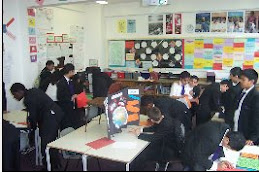
As you might notice, I didn't actually have a noticeboard on the wall so I stapled up some material bought at a market instead. This had the added advantage of being unrippable and my pupils (generally) refrained from writing on it too. At the end of the year you can wash the material then stick it back up re-refreshed in September.


Monday, 6 April 2009

4 Tips for Teachers Without Classrooms

For those teachers who do not have their own classroom, moving materials from place to place can become the bain of your life. Forgetting a particular item can send a well-planned lesson into calamity. Remembering scissors, sellotape, tissues, marker pens is difficult when you are trying to re-set a classroom and make a dash across 4 corridors to your next room.

However, there are few things you can do to make your life a little easier.

1. Get a toolbox

These are reasonably priced and available in homebase, wickes and large tesco stores. Toolboxes have separate containers on the top for easy access to items you use every lesson - e.g. marker pens, stickers, biros.
Inside there are compartments that can lift out where you can keep more precious items - e.g. scissors, glue sticks, hole punch. Mine even houses a teddy bear, a squashy ball and a dictionary!
While students may tease at first, I've found that they are impressed by my organisation and it even inspires them to tidy up their own study bags.

2. Have a box file for each class
Teachers are often wedded to their planners, but having an A4 box file for each class means that you can put any materials for the lesson inside. It can also be used to house exercise books, folders, letters or any work that was left at the end of the class. By carrying it to the next lesson with the class you are immediately 'back where you were' at the end of the previous lesson.

3. Have student 'hosts'
A colleague elected class 'hosts' whose job was to set the classroom up as she made her way to the room. These students pledged to get there early, make sure the room was neat and tidy and get everyone seated. For those who are particularly organised, my colleague would put a sheet with the lesson objectives on the desk before lessons that morning. When she got to the class one of the hosts would already have wrote the objectives onto the board! Only do this if you trust your students with board pens :)

4. 'Where to find me?' cards/notes
Without a classroom students will often struggle to find you at the end of the day. At the beginning of the year I give students a letter which has my email address and 'office hours' on. Before I had an office I used a friend's classroom for a set time after school each week as the time to 'easily find me'. If you can display this somewhere - in the classrooms you teach - or on a website, this will also mean that students can find you at crucial times.
An alternative that I used one summer term was to work in the school library after school. In doing so I could carry on with work but students who needed me could find me. Even better was that staff often did not look there for me so I could work uninterrupted!

Finally...make sure you look after the classroom and return it exactly as it was when you arrived. By doing so the more-permanent teacher might return your requests for display boards or a locked cupboard!